The Real Reason Customers Call Your Competitor Instead
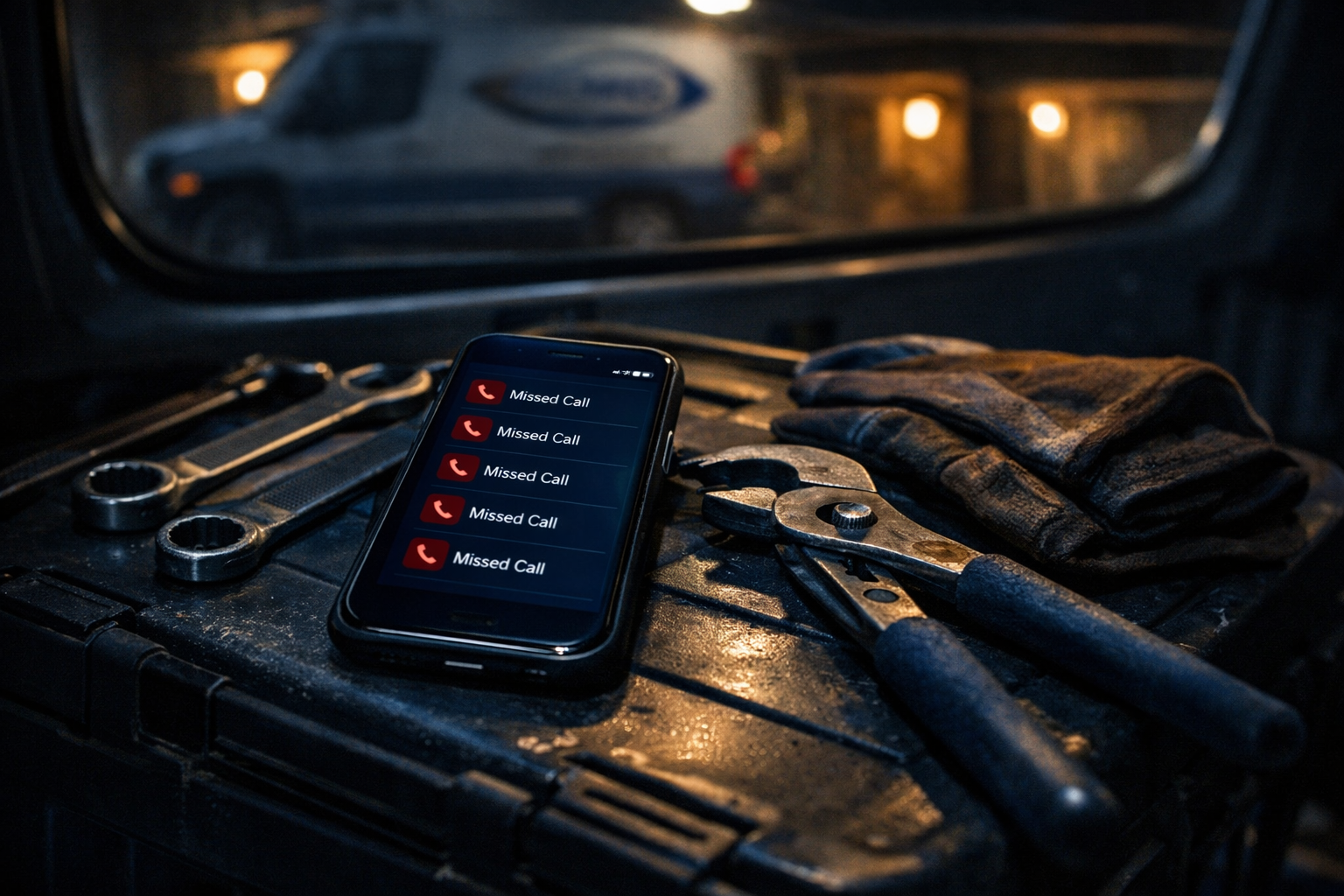
You're under a kitchen sink wrestling with a shutoff valve. Your phone buzzes in your pocket. By the time you get your gloves off and fish it out, it's gone to voicemail. You tell yourself you'll call them back at lunch.
But here's what actually happens: that customer doesn't wait. They dial the next plumber on their screen. Your competitor answers. They book the job. You never hear about it again.
This isn't about being bad at your trade. You're not losing work because you can't sweat a joint or size a compressor. You're losing it because you can't be in two places at once — on the job and on the phone.
Every Missed Call Is a Paycheck Walking Out the Door
Think about the last week. How many calls did you miss while you were on a ladder? In a crawl space? Driving between jobs? Most shop owners guess three or four. Pull your phone records and you'll find it's closer to fifteen.
The math is brutal. If you're missing even ten calls a week, and your average job is worth $500, that's $5,000 in potential revenue gone every single week. Over a year, that's a quarter million dollars you never even knew about.
And it's not just new customers. It's return clients who needed you for an emergency and got someone else's voicemail that actually picked up. It's referrals from your best accounts who called once, got no answer, and moved on. Every single one of those missed calls is choosing your competitor by default.
Why Voicemail Doesn't Work Anymore
Ten years ago, customers would leave a message and wait. Not anymore. They've got five tabs open on their phone, each one a different contractor. Whoever answers first gets the work.
You might think you're fast at callbacks. You probably are. But "fast" in 2025 means answering live, right now, while the customer still has their phone in their hand. Calling back in twenty minutes is too late. They've already booked someone else.
This is especially brutal after hours. A pipe bursts at 9 PM. The homeowner is panicking. They call you, it goes to voicemail, they call three more plumbers. One of them answers. You wake up the next morning to a voicemail about a $2,000 emergency job that's already done — by someone else.
The Answering Service Problem
Some shop owners try answering services. They sound good on paper. In practice, they're a mess.
You get a call at midnight because someone wanted to know your hours. You get "emergency" pages for quote requests that could wait until Monday. The service can't tell the difference between a water heater replacement and a dripping faucet, so they route everything to you like it's life or death.
Or worse, they're so scripted and robotic that customers hang up and call someone who sounds like they actually care. You're paying $200 a month to sound unavailable in a different way.
Hiring someone to answer your phone full-time is even more expensive and complicated. You need someone who understands your business, your pricing, your schedule, and your service area. That's not a $15-an-hour position. And you still can't cover nights, weekends, and holidays without paying overtime or hiring multiple people.
What Your Customers Actually Want
They want to talk to someone who knows what they're talking about. Someone who can tell them if this is really an emergency or if it can wait. Someone who can check your schedule and get them on the books without twenty questions.
They don't care if it's you personally. They care that they're not getting punted to voicemail or stuck in phone tree hell. They want a real conversation with someone who can help them right now.
When your competitor picks up and you don't, the customer doesn't think, "Oh, they must be busy doing great work." They think, "This company doesn't want my business."
How the Best Shops Handle Every Call
The shops that grow year after year don't have superpowers. They've just figured out how to answer the phone every single time it rings, no matter what. They're not missing calls while they're torching copper or pulling wire. They're capturing every lead, booking every job they can handle, and routing actual emergencies without getting dragged off a job site for something that can wait.
They've added a working member to their team who handles calls around the clock. Not an answering service reading from a script. Not voicemail. A smart, trained responder who knows their business.
For most shops, that's Wrenchy. He answers every call in real time, day or night. He knows your services, your pricing structure, and your service area. He can tell the difference between a true emergency and a routine appointment. He qualifies leads, books jobs directly into your calendar, and sends you real-time notifications so you're never out of the loop.
He doesn't take lunch breaks. He doesn't call in sick. He doesn't get flustered when five calls come in at once. And he sounds professional every single time — because he's handling the same questions your customers ask every day.
Your Phone Should Work as Hard as You Do
You didn't get into this business to sit at a desk and answer phones. You got into it because you're good with your hands and you like solving real problems. But you also didn't get into it to leave money on the table because you can't be two places at once.
The solution isn't working longer hours or hiring someone you can't afford yet. It's making sure every call gets answered by someone who can actually help — whether you're on a roof at noon or asleep at midnight.
Stop losing jobs to the guy who just happened to pick up. Your skills aren't the problem. Your availability is. Fix that, and you'll see exactly how much work you've been leaving on the table.
Put Wrenchy to Work in Your Shop
Trades business missed calls add up fast — but you can stop the bleed today. WrenchBot AI is built for shops like yours. Wrenchy answers every call, books jobs, qualifies leads, and keeps you in the loop in real time. You get a 14-day free trial with no credit card required, and most shops are live within 24 hours. Stop missing calls. Start capturing every job that comes your way.
```
Comments
Post a Comment