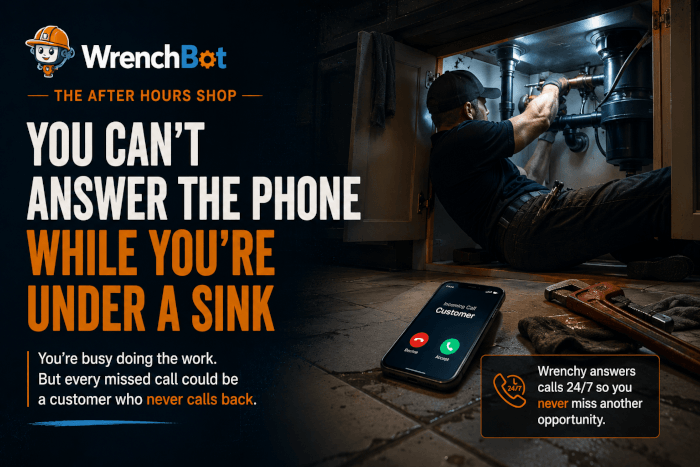
There’s a strange expectation placed on small contractors today.
Customers expect immediate answers. Immediate scheduling. Immediate communication.
At the exact same time, most trades business owners are physically doing the work themselves.
That creates a problem.
You can’t answer the phone while you’re under a sink replacing a shutoff valve. You can’t stop in the middle of troubleshooting an electrical issue to answer every incoming call. You can’t safely pull out your phone while driving between jobs or carrying equipment through somebody’s home.
Yet every missed call could be a potential customer.
That pressure wears on a lot of contractors. Many small shop owners feel like they’re constantly being pulled in two directions. If they focus on the work in front of them, they risk missing new business. If they constantly stop to answer the phone, the actual job suffers.
There’s never really a perfect moment.
That’s especially true for owner-operators and family-run businesses. In many shops, one person is handling almost everything:
- service calls
- scheduling
- customer communication
- estimates
- invoices
- dispatching
- emergencies
And all of that is happening while trying to do quality work and keep customers happy.
It’s exhausting.
The frustrating part is that customers usually don’t see any of this. They simply know whether somebody answered the phone or not. If they don’t get a response quickly, many move on to another company without thinking twice.
That doesn’t mean contractors are failing.
It means the old way of handling calls doesn’t always fit the reality of modern trades businesses anymore.
For years, the options were limited. Hire office staff. Pay for an answering service. Let calls go to voicemail and hope customers leave messages.
None of those solutions are perfect, especially for smaller businesses trying to control costs.
That’s one reason AI phone assistants are starting to become popular in the trades industry. Instead of relying entirely on voicemail, contractors can now have calls answered 24/7, customer information gathered automatically, and emergency situations identified immediately — even while they’re busy on another job.
At WrenchBot AI, we built Wrenchy specifically for that reality.
Not to replace contractors. Not to sound robotic. Just to help small shops stop losing opportunities because they physically can’t answer every call themselves.
Because the truth is simple: You can do excellent work and still lose jobs if nobody answers the phone.
Find out more and sign up for your free trial at WrenchBotAI.com.
Comments
Post a Comment