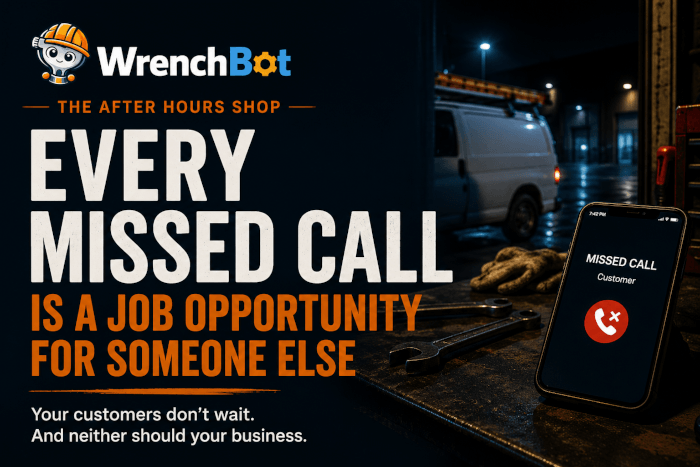
It’s 7:42 PM.
You’re finally home after a long day of service calls. Your knees hurt, dinner’s getting cold, and your phone battery is hanging on for dear life. Then the phone rings.
You glance down at the screen and let it go to voicemail.
Maybe you’ll call them back tomorrow morning.
But the customer never leaves a message. Ten minutes later, they’ve already called another company.
That scenario plays out every single day for trades businesses across the country. Not because contractors are lazy or careless, but because most small shops are stretched unbelievably thin. The owner is often the technician, dispatcher, estimator, scheduler, and customer service department all at once. At some point, something has to give.
Usually, it’s the phone.
The reality is that most contractors don’t lose business because they do bad work. They lose business because they simply can’t answer calls while they’re working. You can’t pick up the phone while you’re under a sink, driving between jobs, troubleshooting an AC unit in an attic, or halfway through a water heater install.
Customers, however, expect quick responses now more than ever — especially after hours.
When someone’s AC quits in the middle of July or a pipe bursts at 10 PM, they are not patiently working their way through a callback list. They’re stressed, frustrated, and looking for the first company that answers. And if they hit voicemail, many won’t even bother leaving a message. They’ll just move on to the next number on Google.
That’s the part many contractors underestimate. Voicemail doesn’t just delay leads anymore. In many cases, it kills them completely.
Most people don’t even like leaving voicemails in their personal lives, let alone during a home emergency. Even a quick response — something as simple as “We received your call” or “Someone will contact you shortly” — can be enough to keep a customer from moving on to a competitor.
What makes this even more painful is that after-hours calls are often some of the most valuable calls a business can receive. These are usually emergency situations, motivated customers, and higher-ticket jobs. They’re not casually shopping around for six estimates. They need help, and they need it quickly.
For years, small trades businesses really only had a few options. Ignore the calls, hire office staff, or pay for a traditional answering service. The problem is that hiring staff is expensive, and many answering services feel impersonal and scripted. Customers can often tell immediately that they’re speaking to a generic call center.
That’s one reason we built Wrenchy.
Wrenchy is an AI phone assistant designed specifically for trades businesses. It answers calls 24/7 in your company’s name, gathers customer information, identifies emergency situations, and helps make sure opportunities don’t slip away after hours.
No call center. No complicated setup. No massive monthly payroll expense.
Just a better way for small shops to stop losing jobs to voicemail.
Because even after the trucks are parked for the night, business is still happening. Customers are still searching. Still calling. Still needing help.
The question is whether someone will answer when they do.
Want to hear how Wrenchy works? Try the free demo at wrenchbotai.com.
Comments
Post a Comment